I just spent one of the more rewarding hours in my studio that I can remember in a long while. I spent it working with encaustic, but in the way I prefer--a way that no one recommends and no one teaches. It's not in any book I've seen, or in any workshop description. I've tried all kinds of techniques in encaustic and gotten frustrated with most of them. Maybe it's a lack of practice or expertise, but I think there's more to it.
I think I got stuck listening to all the other voices out there and forgot to hear my own.
I know what I like to do. Why don't I do it?
I wrote the above months and months ago and saved it as a draft. I was planning to write about how the only voice that matters is your Inner Cheerleader, the one who knows you and knows your heart and loves you no matter what. I was going to explain how you might not know your Inner Cheerleader, and how you could get him or her into a better position to give you help along the way. Because really, we all do know what we want, we just have so many other competing voices in our heads ("it's not practical," "you're not good enough," "people will just make fun of you," "that won't ever make any money," "people like you don't do things like that," "that's NOT how anyone else does it") that we have trouble hearing the fact that what we were doing made us happy.
Sounds great, right? I'm sure it would have been a huge help to the 4.3 regular readers of this blog.
But then those other voices got on top of me, and suddenly nothing in my world seemed right.
I was headhunted (!) for this awesome job. With an awesome company, and awesome people. And when I went in for the interviews, they thought I was awesome too. Cool, they said. Quirky. We like you. In the job I had at the time, I had been consistently criticized by my manager because I didn't act like him, didn't dress the way he wanted me to, didn't talk to people the way he thought I should, didn't play the game he thought we were in. My poor Inner Cheerleader was getting the crap kicked out of her on a daily basis, and all those things were so counter to my nature that when I got a chance to go elsewhere for more money to place where they LIKED what I was bringing to the table, I jumped at it.
I kind of missed the part where it was the same job, which I didn't really love anyway. I thought, "more money will make this work."
It didn't.
I was only about a month ago that I began reading some of my old blog posts, from back around 2008. I was writing about art, about theory, about people and experiences. I was bright and engaged and focused and fun, intellectual and curious.
And then I looked at some of my more recent blog posts and found they were about myself, or my process, or some other thing that had very little crossover to other people. I was dull and disjointed, dispirited, simplistic.
And then I realized the truth. My job was all grind, process, and difficult conversations. There was not the slightest shred of creativity anywhere in it. There was no real learning in it, and no meaningful engagement -- at least, there was no engagement in it that was meaningful to me. My job was making me dull and stupid. My intellect was withering. My creativity was starving. My Inner Cheerleader was in intensive care and barely whispering. One day, I said out loud to myself, "I want my life back."
I wish I could say I had been smart/clever/strong enough to have left on my own; I didn't. The folks at my company were ahead of me in terms of realizing the job was not going to be a fit for me over the long term. So here I am. I have my life back. My time is my own. My world has opened back up, and I'm trying to make good use of it, but I'm anxious about money and survival and all that stuff. I have figured out (with the help of an amazing career coach; our relationship isn't formal yet but as soon as it is I'll clue you in as to who she is and where you can find her) that I need to stop thinking of my profession as WORK, as the Thing I'll Have to Do Until I Drop Dead Because I'll Never Have Enough Money to Retire and instead find the Thing I Never Want to Stop Doing Because I Love It So Much.
I feel at little energized about the future. A little excited. OK, more than a little, but it's hard to go full-out when you're this far of the safety net. You know what I mean.
I can hear my Inner Cheerleader again, very faintly. She's weak, but she's out of ICU and I just heard her say "yay."
Wednesday, April 09, 2014


Monday, March 31, 2014
Healthcare.gov's usability fail
Some of the 4.2 faithful readers of this blog know that, in my other life, I do stuff with web sites. Build 'em, plan 'em, project manage 'em. I've done a little bit of everything with web sites, actually, including strategy development, visual design, information architecture, site-building, programming, all that kind of stuff.
I've been trying to buy health insurance for the better part of the day, and technical problems aside (like we didn't expect those), one of the most bothersome things about the healthcare.gov website is the complete inattention to UX. There are convoluted instructions, conflicting information, vague "help," inconsistent labeling, on and on and on. I'm told that my email address will be my user name when I log into my account, but the email address does not for some reason get me into the account, and at that point I'm told the information I've entered is invalid. I try to change my password, and receive the promised email link to instruct me how to do so, but following that link leads to a page that simply says the operation can't be completed. I attempt to see if there is some problem with my user name, but when I click "recover user name," the page asks me for the email address I signed up with ... which, if I'm remembering correctly, actually IS my username, and then after I type it in, it promises to send an email letting me know how to "recover" my user name ... which never arrives. Subsequent attempts to log into my account result in a screen that says the account is blocked or disabled and provide a number to call ... a number that goes directly to a recording informing me that there is a "high volume" of calls and telling me to call back later. Awesome.
The biggest problem with all this is of course that the website is clearly on the fritz again. But that could have been mitigated by some sensible UX decisions. Clear directions, any kind of opportunity to leave at least the impression that a concern or complaint could be articulated to someone who could hear it, that efforts to resolve problems independently would not automatically lead to other problems ... so many opportunities, all of them blown.
UX is not rocket science. Good usability is common sense. Apparently, though, common sense has been in short supply in the development of healthcare.gov.
I've been trying to buy health insurance for the better part of the day, and technical problems aside (like we didn't expect those), one of the most bothersome things about the healthcare.gov website is the complete inattention to UX. There are convoluted instructions, conflicting information, vague "help," inconsistent labeling, on and on and on. I'm told that my email address will be my user name when I log into my account, but the email address does not for some reason get me into the account, and at that point I'm told the information I've entered is invalid. I try to change my password, and receive the promised email link to instruct me how to do so, but following that link leads to a page that simply says the operation can't be completed. I attempt to see if there is some problem with my user name, but when I click "recover user name," the page asks me for the email address I signed up with ... which, if I'm remembering correctly, actually IS my username, and then after I type it in, it promises to send an email letting me know how to "recover" my user name ... which never arrives. Subsequent attempts to log into my account result in a screen that says the account is blocked or disabled and provide a number to call ... a number that goes directly to a recording informing me that there is a "high volume" of calls and telling me to call back later. Awesome.
The biggest problem with all this is of course that the website is clearly on the fritz again. But that could have been mitigated by some sensible UX decisions. Clear directions, any kind of opportunity to leave at least the impression that a concern or complaint could be articulated to someone who could hear it, that efforts to resolve problems independently would not automatically lead to other problems ... so many opportunities, all of them blown.
UX is not rocket science. Good usability is common sense. Apparently, though, common sense has been in short supply in the development of healthcare.gov.
Monday, December 30, 2013
Becoming Me
If you're one of the 2.3 regular readers of this fine blog, you'll no doubt recall that I've been giving photo/video a bit of a rest and working instead in encaustic, which is basically painting for gearheads. (No wimpy little brushes for me, no sir! Tacking iron, industrial-strength heat gun, blow torch ... now we're talking!) I've had some really good results and some disasters, and a handful of things I'm not quite sure I understand. I've spent a lot of time going back and forth trying to improve my technique and oftentimes not being sure if what I was creating was a bug or a feature, if you know what I mean. But I remained disturbed and dissatisfied ... my work didn't look like the work of the encaustic artists I admire, like Cari Hernandez, Joyce Gehl, Bobbette Rose, Daniella Woolf. And I really, really wanted it to.
I think I'm at a place now where I understand that Cari's and Joyce's and Bobbette's and Daniella's work looks the way it does because it's their work. It's what they do. Maybe this style I've been working so hard to "improve" is actually my style, my work, what I do. It is for now, at least. So I'm changing my point of view a bit, focusing on understanding the work, rather than on "improving" it. That's remarkably freeing, and if you are an artist striving toward "improvement," I highly recommend it, at least as a temporary thing.
There were a number of folks I knew in art school who really wanted me to paint. I worked primarily in photo and video, with a hefty dose of sound, book, and installation art thrown in--basically, anything that wasn't painting. I kinda-sorta tried it; I had one watercolor class in grad school, which convinced me that I was clearly not meant for watercolor, and I did one painting for another class during which the instructor fell asleep during my presentation. These episodes were not the least of my discouragement from working in paint, however. I had friends who were painters who took my breath away, and I was 100% certain that I was not going to be creating anything with paint that looked like Jenn Shiflett or Elise Morris or Gail Weissman or Nora Cohen or Lisa Rasmussen. Thinking about it now, that should have been okay. But it wasn't. I didn't want to be me as a painter. If I was going to paint, I wanted to be them.
So here's the weird thing. In my interest in making my encaustic work look like (someone else's -- fill in any name here), I decided that perhaps it was my lack of actual painting skills and technique that was keeping my work from feeling satisfactory. So recently I began to look into that painting thing. You know, with the wimpy brushes. And little tubes of oil or acrylic. I even put a painting technique book on my Holiday Wish List ... and thanks to my adoring boyfriend, I got it.
I've already blasted through it, and am re-reading it a third time. The thing that strikes me is that so many of the techniques are similar (or at least referential) to what I'm already doing in encaustic, so in a lot of ways it feels kind of familiar. There were a couple of cool and unusual processes that I got very enthused about, so I have already a small chunk of money on paint and gels and assorted hoo-hah of that nature and spent a good chunk of time tonight either playing with paint or setting up things so I could play with paint later. It will be interesting to see if anything comes of it, if I am supposed to be a painter after all, despite one medium failure, one crappy instructor, and my boatload of uber-talented friends.
I'll leave you with a little bit of an in-joke. Here is a new encaustic work of mine at an early phase, followed by the work I did on it tonight. (In case you're wondering, I'm happier with it now, but think it still needs a little more work.)
I think I'm at a place now where I understand that Cari's and Joyce's and Bobbette's and Daniella's work looks the way it does because it's their work. It's what they do. Maybe this style I've been working so hard to "improve" is actually my style, my work, what I do. It is for now, at least. So I'm changing my point of view a bit, focusing on understanding the work, rather than on "improving" it. That's remarkably freeing, and if you are an artist striving toward "improvement," I highly recommend it, at least as a temporary thing.
There were a number of folks I knew in art school who really wanted me to paint. I worked primarily in photo and video, with a hefty dose of sound, book, and installation art thrown in--basically, anything that wasn't painting. I kinda-sorta tried it; I had one watercolor class in grad school, which convinced me that I was clearly not meant for watercolor, and I did one painting for another class during which the instructor fell asleep during my presentation. These episodes were not the least of my discouragement from working in paint, however. I had friends who were painters who took my breath away, and I was 100% certain that I was not going to be creating anything with paint that looked like Jenn Shiflett or Elise Morris or Gail Weissman or Nora Cohen or Lisa Rasmussen. Thinking about it now, that should have been okay. But it wasn't. I didn't want to be me as a painter. If I was going to paint, I wanted to be them.
So here's the weird thing. In my interest in making my encaustic work look like (someone else's -- fill in any name here), I decided that perhaps it was my lack of actual painting skills and technique that was keeping my work from feeling satisfactory. So recently I began to look into that painting thing. You know, with the wimpy brushes. And little tubes of oil or acrylic. I even put a painting technique book on my Holiday Wish List ... and thanks to my adoring boyfriend, I got it.
I've already blasted through it, and am re-reading it a third time. The thing that strikes me is that so many of the techniques are similar (or at least referential) to what I'm already doing in encaustic, so in a lot of ways it feels kind of familiar. There were a couple of cool and unusual processes that I got very enthused about, so I have already a small chunk of money on paint and gels and assorted hoo-hah of that nature and spent a good chunk of time tonight either playing with paint or setting up things so I could play with paint later. It will be interesting to see if anything comes of it, if I am supposed to be a painter after all, despite one medium failure, one crappy instructor, and my boatload of uber-talented friends.
I'll leave you with a little bit of an in-joke. Here is a new encaustic work of mine at an early phase, followed by the work I did on it tonight. (In case you're wondering, I'm happier with it now, but think it still needs a little more work.)
 |
| New encaustic. It felt just a bit too lurid, the colors too bright and clumsy. |
 | |
| Painting improved, using heavily watered acrylic paint. Ha ha. |
Wednesday, February 13, 2013
Narwhal, Sea, and Sky
I have not been blogging very much, and for that I do apologize to my loyal 4.2 readers (I'm convinced my social media activities have led to a definitely uptick in popularity). But it's time to start again and get on a somewhat regular schedule. I'll begin by showing you a little of what I've been doing most recently.
I've been working on a 3Dish mixed media encaustic piece for some time. It's one of those things where you just start without really knowing what you're going to be doing, and then you do something, and it makes some sense, but then you lose the plot and float around again until something else makes sense. So it has been for "Narwhal, Sea, and Sky." I decided long ago that I wanted to use joint compound to create a form of some kind that would then be covered with wax; I'd heard it's a wonderful ground for wax and it's very easy to shape and mold--much easier, I imagine, than wax itself would be. So I sat down with a cradled wooden panel and smeared on some joint compound and just kept playing with it until suddenly it became a whale. Well, not quite a whale. A Narwhal. Or at least that's what it told me it was.
Narwhal went through a lot of phases, with me alternating between thinking it was delightful and complete junk. This is not unusual for any artist who works on a single project for a long period of time, I don't think. I seem to experience this in reverse with my photography; I'll look through the camera roll and suddenly spot something that seems wonderful that I had previously dismissed as a throw-away shot. (This is why I never actually delete anything.)
I think I've probably been working on Narwhal for six months, wondering what it would be. Here is a little bit of a visual representation of its journey from start to what I believe is completion ... although you never know. Ha.
 This is Narwhal in its very beginning. Here you see only the board and the initial application of joint compound, and my whale form painted with gray oil paint. You can see that I've noodled around some with the style and design, but it's basically pretty raw and at this point I had no idea where it was going. I tried using rubber stamps in the joint compound, but that really didn't work so well, so I abandoned that approach and focused on using my hands to craft the flow and the shapes.
The hand-shaping made it more like sculpture and more personal, somehow. I enjoy tactile experiences, and as a photo/video/mixed reality artist, I have not generally had the opportunity to have this when making art.
 In this image you see Narwhal in a later stage of progress. I applied a layer of oil paint onto sections of the piece and began buttering it over with encaustic medium. I knew for some reason that I wanted it to feel like icing on a cake. I applied several layers of medium until I felt I had that effect. I also experimented with gold oil paint on some starlike "points" in the sky section of the piece, but was not altogether pleased with the result. However, I still thought that, in its final version, those stars would somehow be visible.
 Here you see Narwhal much further along, with multiple layers of pigmented wax applied to both the sea and sky sections. The whale itself has had a light application of clear medium as well, which I felt made it feel more integrated into the rest of the piece. While I wanted the whale to be distinct, I didn't want it to feel like it was sitting above the encaustic, but instead to feel like it was swimming through it, possibly popping up for air.
 And here is Narwhal after I massaged the entire piece with iridescent pearl oil bar from R&F. I like the way this seems to bring the whole piece together and unify it. The whale feels to me as if he is diving from a visit to the night sky back into the sea. He is a traveler whale, a mystic, a representation of something else. perhaps this is why he wanted me to call him a Narwhal ... "whale" is not an unusual thing, although it is a graceful and extraordinary thing. Narwhals are not really whales, they are more closely related to dolphins, and the males (and sometimes the females) grow a single very long tooth or "tusk" that makes them look like fishy unicorns. My Narwhal does not have a tusk, but perhaps it is a female Narwhal or a baby.
As it turns out, narwhals have quite a fan club. Just Google "narwhal" and you'll find Narwhal pictures and Narwhal cartoons and Narwhal oddities (what Dr. Who would look like if he were a Narwhal) and Narwhal huggable plush toys. I've added a few images to my Pinterest. There is just something delightfully unusual about them.
I hope that is at least what people think about the work I've created, that it's delightfully unusual. I'd especially like people to consider it and wonder about it (what was that Narwhal doing in the sky? And why, after all, is it a Narwhal and not a whale or a dolphin or a seabird or something else?). I'm very fond of it, and I'm beginning to think I've underpriced it ($310). But we'll let it fly out there and see what happens. I know it means something to me, and the next step is to let that meaning percolate up and make itself apparent to me, and to find out what it might mean to other people. All in good time, friends. All in good time.
I've been working on a 3Dish mixed media encaustic piece for some time. It's one of those things where you just start without really knowing what you're going to be doing, and then you do something, and it makes some sense, but then you lose the plot and float around again until something else makes sense. So it has been for "Narwhal, Sea, and Sky." I decided long ago that I wanted to use joint compound to create a form of some kind that would then be covered with wax; I'd heard it's a wonderful ground for wax and it's very easy to shape and mold--much easier, I imagine, than wax itself would be. So I sat down with a cradled wooden panel and smeared on some joint compound and just kept playing with it until suddenly it became a whale. Well, not quite a whale. A Narwhal. Or at least that's what it told me it was.
Narwhal went through a lot of phases, with me alternating between thinking it was delightful and complete junk. This is not unusual for any artist who works on a single project for a long period of time, I don't think. I seem to experience this in reverse with my photography; I'll look through the camera roll and suddenly spot something that seems wonderful that I had previously dismissed as a throw-away shot. (This is why I never actually delete anything.)
I think I've probably been working on Narwhal for six months, wondering what it would be. Here is a little bit of a visual representation of its journey from start to what I believe is completion ... although you never know. Ha.

The hand-shaping made it more like sculpture and more personal, somehow. I enjoy tactile experiences, and as a photo/video/mixed reality artist, I have not generally had the opportunity to have this when making art.


As it turns out, narwhals have quite a fan club. Just Google "narwhal" and you'll find Narwhal pictures and Narwhal cartoons and Narwhal oddities (what Dr. Who would look like if he were a Narwhal) and Narwhal huggable plush toys. I've added a few images to my Pinterest. There is just something delightfully unusual about them.
I hope that is at least what people think about the work I've created, that it's delightfully unusual. I'd especially like people to consider it and wonder about it (what was that Narwhal doing in the sky? And why, after all, is it a Narwhal and not a whale or a dolphin or a seabird or something else?). I'm very fond of it, and I'm beginning to think I've underpriced it ($310). But we'll let it fly out there and see what happens. I know it means something to me, and the next step is to let that meaning percolate up and make itself apparent to me, and to find out what it might mean to other people. All in good time, friends. All in good time.
Wednesday, July 04, 2012
Froth of July
 |
| RWB 1 6 x 9 inches encaustic on canvasboard |
For this piece, I layered the medium and pigmented wax on a 6 x 9 inch canvasboard, then worked the layers with my awesome new heat gun and fan nozzle. I've spent a year wondering how other encaustic artists achieved this lacy, foamy effect, and the answer is basically having the right tool. I could never have accomplished this with my little craft heat gun, even if it had some kind of attachment that enabled me to direct the airflow.
 |
| RWB 2 4 x 6 inches encaustic on wood |
I'll leave you with a couple of detail images from RWB 1. I'm going to continue working with this technique and see how many more effects I can draw out of it. I'm pleased with my progress so far.
 |
| detail from RWB 1 |
 |
| detail from RWB 1 |
Saturday, June 30, 2012
Technique-a-aplooza Part 1
After a day spent working alongside one of my favorite local artists in her studio, I'm starting to understand that my fledging encaustic practice is actually a little further along than I thought. I've had in my head for awhile what I wanted my encaustic work to look like, but kept thinking I didn't have enough knowledge or had never found the right technique for it or even, possibly, that I just didn't possess the necessary talent (and I just heard every other artist reading this go "eeeeeEEEEEEEEE...").
As it turns out, none of those things are true. And doing a survey of my encaustic work to date, there are quite a few pieces I'm very happy with (including the three that now live in other people's homes) that show a reasonable ability to execute a wide variety of techniques; some of these early pieces are almost purely about the techniques themselves. Here are a few for your enjoyment!
Possibly the most straightforward of the techniques is just the application of layered wax, creation of marks in the wax and then infilling with contrasting paint or wax. Western Starshower started as something else entirely. I've always been vaguely dissatisfied with the piece, until one day I turned it upside down and suddenly it made sense. I like the texture and sort of 3D quality of the black hills in the foreground. At the same time, though, I don't think this is one that will ever make it to the sale table; it's just a little bit too rough.
Bengali is another piece that began as one thing and became another. There are so many techniques in this tiny piece I almost don't know where to begin talking about it. It's got layered overpainting, scraping away, "buttering" with the tacking iron, and a final layer of gold oilbar highlight. I have to say the addition of the gold is what kind of turned it from "nothing" into "something." I'll probably frame this one and put it up in my house somewhere. I haven't been able to make a photo of it that did it justice.
Speaking of buttering, Buttery is tacking-iron process run a little bit amok. This is purely overpainting and then pulling back the wax to varying depths with the tacking iron, revealing the different colors beneath. Again, I'm a fan of texture that implies 3D rather than 2D--the wax "sits up" in waves, the colors surprise, the form feels at once chaotic and elegant. In the same style is the much larger Misty Garden. It's less tactile, a little bit more glassy, but still with the technique of using the tacking iron to butter back layers of color to reveal unexpected layers of color underneath. On this one, though, I've also used the tacking iron to "style" the wax colors into patterns and waves.
I'm not a big fan of image transfer processes in encaustic; most of the work I've seen that uses image transfer feels too much like a graphic design or collage project to me, and I've never had any illusions about being interested in working in either of those styles. But there can be something magically about the inclusion of printed images in this work if handled with a slightly different point of view. My two favorites in this style are Winter Trees and Leaf. Each uses a very different technique. Winter Trees involved embedding an inkjet print on rice paper into the wax; Leaf also features embedded designs on rice paper, but instead of an inkjet print, I made multiple pastel rubbings of the leaf in different colors and carefully layered those to make the final piece. A little bit of oil paint was used to emphasize highlights and details.
I had the good fortune to know a number of extraordinary painters in grad school, and what they did seemed like magic to me; I've never painted and felt pretty confident that I couldn't ever create anything that looked like it had come off the end of a brush held by Lisa or Gail or Elise or Jenn, Mo or Anastasia or Nora. These artists still amaze me, and I'm not shy about saying they are all my inspirations when it comes to encaustic. This last piece is the closest to what I want to be as an encaustic artist, and rather than my previous assumption that I just probably didn't have the ability to create work like that, it turns out it was just another technique, combined with a tool problem. Some thought, some luck and the proper tool are what helped me produce this piece, which doesn't have a title yet. But creating this was so satisfying (and surprising), it defies description.
I have in my head now what I need to do to continue to produce work like this, the trick will be to keep working and be willing to fail. That's a good lesson both for art and life in general.
As it turns out, none of those things are true. And doing a survey of my encaustic work to date, there are quite a few pieces I'm very happy with (including the three that now live in other people's homes) that show a reasonable ability to execute a wide variety of techniques; some of these early pieces are almost purely about the techniques themselves. Here are a few for your enjoyment!
 | |||
| Western Starshower 6 x 4 inches wax and oil paint on wood |
 |
| Bengali 3 x 5 inches wax and oil on canvas panel |
 |
| Buttery 5 x 7 inches wax on encaustic board |
 |
| Misty Garden 8 x 8 inches wax on wood panel |
 |
| Winter Trees 3 x 5 inches wax and inkjet print on encaustic board |
 |
| Leaf 3 x 5 inches wax and pastel rubbings on encaustic board |
 |
| untitled 9 x 12 inches wax on clay board |
I have in my head now what I need to do to continue to produce work like this, the trick will be to keep working and be willing to fail. That's a good lesson both for art and life in general.
Sunday, June 03, 2012
Irony Sandwich ... Art Show in AVN!
After a series of random connections and pleasant events, my first art exhibition in the 3D virtual world Avination is now open. It doesn't have an official title, but I'm thinking of it as "Irony Sandwich," not just because of the work, but also because of the way it came into being.

First, the important details:
Show star: Me. Only in Avination, I'm Winterlight Cazalet. Now you know. :)
Show location: Oasis of Art, Inspiration Terrace, Southern Bay sim, AVINATION.
Reception: Sunday, June 10, 4-5 pm PST (that's 7-8 pm eastern, and midnight to one for all you fabulous euros).
I would LOVE for anyone with a computer that has the chops to join us at this reception. Even if you've never set foot in a 3D Virtual World for any reason, please do so for just this one hour. It's absolutely free to join, it's easy, you will not receive a lot of stupid email spam for joining, and I will not be bothered at all by a lot of noobs at the reception. In fact, the sight of a noob in AVN thrills me to death!
 All you have to do is go to the Avination sign-up page, create your account, download the Avination viewer, and log in. If you're already in Second Life, you can keep your SL name and even use some of the same viewers to log in (Firestorm and Imprudence both work just fine for AVN viewing and have the grid already listed among their login options; all you need to do is fill in your AVN avatar name and chosen password). Once you are inworld, just use search to find my avatar name, and send me an instant message if I'm online or use the landmark in my profile to get to the show.
I have 15 works on display. Now for the "Irony" part: they're all digital photographs of real-world things; works that I've actually produced and shown in what people like to call "real life." They're "real" pictures, but they're digital. And now they're being produced and shown in a "virtual" space. Given my ongoing interest in blurring and underscoring the arbitrariness of the separation between "virtual/digital" and "real," you can perhaps see why I find this amusing on a lot of levels.
So, come have a look at my Irony Sandwich. It will be up throughout June and maybe longer. And for all you artists already working in other 3D VR environments, please come have a look at Avination. I have a dream of this place becoming "the artists' grid," and I'll need your help to get there.

First, the important details:
Show star: Me. Only in Avination, I'm Winterlight Cazalet. Now you know. :)
Show location: Oasis of Art, Inspiration Terrace, Southern Bay sim, AVINATION.
Reception: Sunday, June 10, 4-5 pm PST (that's 7-8 pm eastern, and midnight to one for all you fabulous euros).
I would LOVE for anyone with a computer that has the chops to join us at this reception. Even if you've never set foot in a 3D Virtual World for any reason, please do so for just this one hour. It's absolutely free to join, it's easy, you will not receive a lot of stupid email spam for joining, and I will not be bothered at all by a lot of noobs at the reception. In fact, the sight of a noob in AVN thrills me to death!

I have 15 works on display. Now for the "Irony" part: they're all digital photographs of real-world things; works that I've actually produced and shown in what people like to call "real life." They're "real" pictures, but they're digital. And now they're being produced and shown in a "virtual" space. Given my ongoing interest in blurring and underscoring the arbitrariness of the separation between "virtual/digital" and "real," you can perhaps see why I find this amusing on a lot of levels.
So, come have a look at my Irony Sandwich. It will be up throughout June and maybe longer. And for all you artists already working in other 3D VR environments, please come have a look at Avination. I have a dream of this place becoming "the artists' grid," and I'll need your help to get there.
Monday, April 16, 2012
Creative Worlds
Important note: click on the images to view full-size. Worth it, I promise.
If you're one of the 3.3 (woot!) regular readers of this blog, you'll know that I'm an active participant in and booster of art in 3D virtual worlds; to date I've curated a couple of mixed-reality experiences and have several unrealized projects on the boards. In Second Life in particular, I count as my friends a number of wonderful artists whose work I enjoy and admire. My own particular bent when it comes to this artistic medium is one of integration and interrelation, blurring the boundaries between the "real" and the "digital/virtual," even though (or perhaps because) this distinction feels largely false to me. "Digital" is not, after all, the opposite of "real;" it's merely a label we apply to experiences in a particular environment to distinguish them from one another, just like "sparkling wine" is not the opposite of "champagne." It's the same thing, really; it just happens in a different place.
I'm really excited about my latest ideas for a large-scale installation in a virtual world setting, complete with real-world integration. I missed the deadline for application for Linden Endowment for Art support, sadly, so now I'm trying to decide what to do. Art support organizations are still around Second Life, but like the rest of us they are largely cash-strapped, and most have restricted or eliminated programs that supplied full sims (that's like giving an artist a private island, for you non-virtual-world readers) as Linden Labs has dramatically raised its sim rates for nonprofits and educational institutions. And like those organizations, I would have a hard time affording a full sim on my own, even for just a few months.
The good news is that Second Life is no longer the only game in town. A handful of competing 3D virtual worlds have made a lot of headway in stabilizing their platform and creating enhancements that put them nearly on par with Second Life (which admittedly remains the Big MacDaddy of 3D Virtual Worlds). Right now I have an avatar floating around in four of them: Blue Mars, InWorldz, OSGrid and Avination. Although OSGrid seems to be populated by old developer friends from SL's early days, I find myself feeling pretty comfortable in Avination. For one thing, this was the world that made it easiest for me to look like myself (the self I am in Second Life, that is). For another, the platform seems very stable and is under active development, and many of the features I like the most from SL are present in Avination as well--they've done a good job of building on SL's open source code base.
One last good thing ... Avination is cheap. Free to join, a slightly better currency exchange rate for the US dollar than SL, and full sims are actually affordable and don't carry ludicrous set-up fees.
The cons ... there are a few things I'd like to do that aren't supported in Avination yet, although I hear they're on the way. And there are significantly fewer regular users of Avination than of SL; this may be a hidden plus, and may, if I get my way, not be too difficult to work around in the end. Additionally, setting up the project in Avination could be a good "proof of concept" for something I might do later on in Second Life, giving me the opportunity to tweak and polish it before turning it loose on a larger, higher-visibility audience.
You're probably wondering what this mysterious mixed-reality project is about. As with all my projects, I could give you a long description of what I think it's about, but by the time it's finished it might not be about that at all. I can tell you my goals are forming around including both worlds in each world in a much more tangible way that I've seen done before, and focused on enabling interaction across the worlds that isn't about performance or "re-creation" or mere representation or scripted scenarios. I can tell you that I'm being inspired by a convergence of repeated references ... to William Gibson's "Idoru," to Jill Bolte Taylor's Ted Talk, to steampunk and strange shapes and things that repeat and repeat and repeat. Movement, light, mystery, poetry. Sound. Quantum physics. Music. Asparagus.
I'm building and scripting this install myself; if I can't figure out how to do it, then it must not want to be done. I've started making strange and beautiful things in Avination that really have no definition, I can't really tell you what they are. But they move and glow and turn slowly and change color and tell you secrets, fly and bounce, rotate and change, all unbidden, all in the spirit of self-direction.
Eventually, they will hold as many secrets as they tell. Eventually they will offer whole stories, that I hope the viewer will assemble in whatever way is most meaningful to them. Because at the end of the day, art is really a collaborative effort between the artist and the viewer, and I want to offer as many people as I can a window between these two wonderful mystical worlds that we could all inhabit, each with its own sorrows and illusions, each with its own amazing points of wonder.
If you're one of the 3.3 (woot!) regular readers of this blog, you'll know that I'm an active participant in and booster of art in 3D virtual worlds; to date I've curated a couple of mixed-reality experiences and have several unrealized projects on the boards. In Second Life in particular, I count as my friends a number of wonderful artists whose work I enjoy and admire. My own particular bent when it comes to this artistic medium is one of integration and interrelation, blurring the boundaries between the "real" and the "digital/virtual," even though (or perhaps because) this distinction feels largely false to me. "Digital" is not, after all, the opposite of "real;" it's merely a label we apply to experiences in a particular environment to distinguish them from one another, just like "sparkling wine" is not the opposite of "champagne." It's the same thing, really; it just happens in a different place.
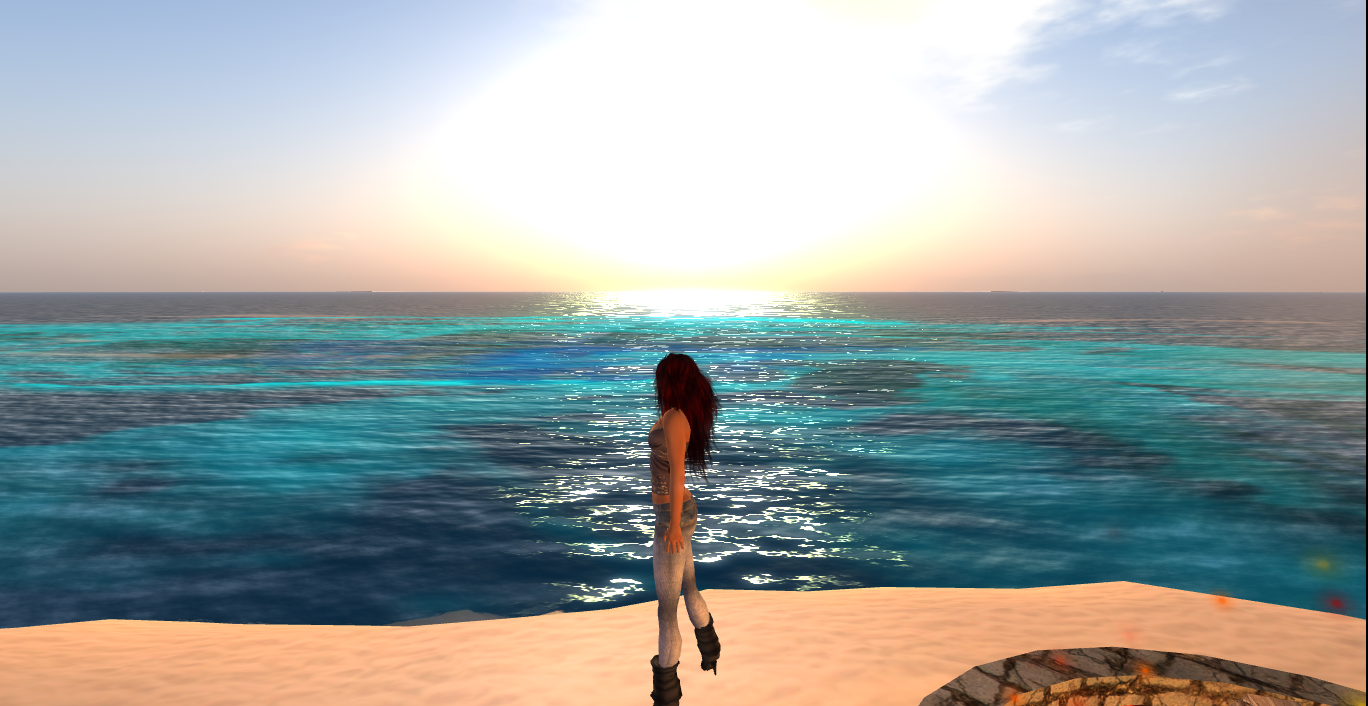 | |
| Me at home in Avination. In 3D virtual worlds, it seems that everyone lives on the beach. |
 |
| Weird thing with another weird thing inside it. |
One last good thing ... Avination is cheap. Free to join, a slightly better currency exchange rate for the US dollar than SL, and full sims are actually affordable and don't carry ludicrous set-up fees.
 |
| Another beautiful weird thing |
You're probably wondering what this mysterious mixed-reality project is about. As with all my projects, I could give you a long description of what I think it's about, but by the time it's finished it might not be about that at all. I can tell you my goals are forming around including both worlds in each world in a much more tangible way that I've seen done before, and focused on enabling interaction across the worlds that isn't about performance or "re-creation" or mere representation or scripted scenarios. I can tell you that I'm being inspired by a convergence of repeated references ... to William Gibson's "Idoru," to Jill Bolte Taylor's Ted Talk, to steampunk and strange shapes and things that repeat and repeat and repeat. Movement, light, mystery, poetry. Sound. Quantum physics. Music. Asparagus.
 |
| Two more weird things that move. How they move is still secret :) |
 |
| Good night from Avination. |
Sunday, January 22, 2012
Light! Depth! Fuego!
I've been thinking more about my encaustic process lately, which you'll no doubt remember if you're one of the 3.3 (woot!) regular readers of this blog, and I've been spending a lot of time looking at the work of other artists I admire. Just in the year I've been working in this medium, there seems to have been a tremendous increase in the number of artists producing extraordinary fine art in encaustic. When I first got interested, all I could find online were crafters and collage, neither of which felt like what I wanted to do. Then I discovered Lissa Rankin, Cari Hernandez, Linda Womack, and (locally) Diane Rodman. Just recently, I took another tour around the web and found even more artists whose work inspires and amazes me: Lisa Kairos, Elise Wagner, and Molly Cliff-Hilts, among many others.
One of the good things about finding these artists and lots of online images of their work is that it gives me a chance to think about my work in relationship to theirs, not in terms of making it like theirs, but considering the elements in their work that I respond to, and how to bring those elements into my own form of expression.
 |
| an early experiment with incorporating 3D objects |
I've experimented briefly with incorporating three-dimensional objects into my wax pieces but largely have not been wildly happy with the results. I've also attempted making the wax itself more of a three-dimensional feature, and I've liked those results a little bit better, although I haven't tried to do anything with the stiffer "modeling wax" designed for that purpose. At the end of the day, it's the magic I think I want to incorporate, the illusion of depth in something that is otherwise obviously flat. (Actually, I recognize this kind of "misdirection" is a fairly consistent theme in all of my work, the moment of wondering--however briefly--"Am I looking at what I think I'm looking at?")
 |
| Experiment with 3D wax |
 |
| Front view of the experiment in 3D wax. I actually like this piece a lot. |
In looking at the photos I've produced of my experiments in luminosity and depth (the illusion of 3D), I find I'm not really able to capture the subtleties all that well, and I think that's probably fine. I can see things that are not quite right with all of these pieces, and I will keep working on them to enhance them. I think a scan, rather than a photograph, is probably going to be the best way to capture them; the light from the scanner does a pretty good impression of ambient light's effect on the pieces and shows off the luminosity and depth a little better. But for the time being, here are some examples of where I hope to go:
In order to achieve these effects consistently and to refine them in the way that will work for me, I know I need to have better control over the wax, especially when fusing and heating the surface to apply more wax. My little craft air gun is a bit clumsy and it's really easy to go just past that "warmed" state into "liquid." While that's an effect I generally like (overfusing R me), sometimes you need for those layers to remain separate and relatively unadulterated if you're going to represent depth. My tacking iron offers me a little bit more precision, but it's easy to accidentally smear colors and layers in a way that makes them muddy--this is, I realize, largely a matter of practice. Anyway, there is one clear way to quickly heat the wax to the perfect temperature for fusing and for laying down more layers in a way that is precise and effective. And despite my anxiety over it, I've gone ahead and done it ...
... I bought a blow torch.
 Okay, so I got the little one, light weight and butane-powered, but it has an adjustable flame and a trigger ignition, along with a switch to power a continuous flame. And it came with a little soldering tip, so my further adventures in metalworking (more on that later) can also be furthered. It *should* work fine, once I figure out what I'm doing. I'm still afraid of it enough that I haven't taken it out of its package, but give me a few days and I'm sure I'll be blazing away. It never takes me long to work up the courage to jump into something new, and once I commit to a process, I'm in all the way.
Think I'll get myself a fire extinguisher first, though. Just in case.
 |
| You can see the glow of the little heart form standing out from the surrounding darker wax, left. On the right, there are intimations of depth conveyed by the layering of clear medium and pigmented paint. These are actually opposite ends of the same piece, both ends need some major refinement, but at least I've started to achieve what I was going for. |
In order to achieve these effects consistently and to refine them in the way that will work for me, I know I need to have better control over the wax, especially when fusing and heating the surface to apply more wax. My little craft air gun is a bit clumsy and it's really easy to go just past that "warmed" state into "liquid." While that's an effect I generally like (overfusing R me), sometimes you need for those layers to remain separate and relatively unadulterated if you're going to represent depth. My tacking iron offers me a little bit more precision, but it's easy to accidentally smear colors and layers in a way that makes them muddy--this is, I realize, largely a matter of practice. Anyway, there is one clear way to quickly heat the wax to the perfect temperature for fusing and for laying down more layers in a way that is precise and effective. And despite my anxiety over it, I've gone ahead and done it ...
... I bought a blow torch.

Think I'll get myself a fire extinguisher first, though. Just in case.
Tuesday, January 17, 2012
No Matter Where You Go, There You Are
Some things that have been bugging me lately:
If you're one of the 2.3 regular readers of this blog, you already have read my rant on POV. Some people seemed to think this was a cry for help, or some kind of problem I was having. It wasn't; and it's not. Thank you to my dear friend Judy Shintani for serendipitously reminding me that it's actually my process, and that makes it just fine. I need a POV. I get to decide that for myself. If you don't need a POV, I'm happy for you, yay! But I'm just as happy for me that I understand that I need one and have the sense to keep working toward it. And yes, it's discovery that comes from work. Generally, from a lot of work.
Second thing: I have seen posted on Facebook by a couple of very different friends an absolutely idiotic quote attributed to Andre Gide, "Art is a collaboration between God and the artist and the less the artist does, the better." I almost cannot express how much this pisses me off. Once again, intention, focus, engagement, concept, and conscious choice in artmaking gets dissed in favor of some special magical outside force we're all just channeling. Talent's not real, choices are meaningless; we're just empty vessels. If the work is good, it must be because we didn't have anything to do with it! If it sucks, it's because we participated too much in the creation of our own work.
You can perhaps see, I think, how these two things are related. Each assumes that an engaged intellect is either not necessary or not helpful in making art.
While there is something to the notion of avoiding paralysis by analysis and getting out of your own way, there is NOTHING in the notion that not being conscious and deliberate in your artmaking somehow makes it better. Having no conceptual underpinning (which is really artschool talk for "an idea about what you are doing") doesn't make your work special, it makes it rootless. I can look at my crafty things or the stuff I've done just for myself, and I can see that. I see it in others' work as well. It keeps it from being everything it should be.
And once again, a serendipitous post from Judy ... "Being quiet enough to listen and trusting is the only way into creativity." But she and I agree. We aren't listening for the voice of God or trusting some outside force; we're listening to "our own true voices."
Whew, I feel better. More fun next post and less pondering. I promise.
If you're one of the 2.3 regular readers of this blog, you already have read my rant on POV. Some people seemed to think this was a cry for help, or some kind of problem I was having. It wasn't; and it's not. Thank you to my dear friend Judy Shintani for serendipitously reminding me that it's actually my process, and that makes it just fine. I need a POV. I get to decide that for myself. If you don't need a POV, I'm happy for you, yay! But I'm just as happy for me that I understand that I need one and have the sense to keep working toward it. And yes, it's discovery that comes from work. Generally, from a lot of work.
Second thing: I have seen posted on Facebook by a couple of very different friends an absolutely idiotic quote attributed to Andre Gide, "Art is a collaboration between God and the artist and the less the artist does, the better." I almost cannot express how much this pisses me off. Once again, intention, focus, engagement, concept, and conscious choice in artmaking gets dissed in favor of some special magical outside force we're all just channeling. Talent's not real, choices are meaningless; we're just empty vessels. If the work is good, it must be because we didn't have anything to do with it! If it sucks, it's because we participated too much in the creation of our own work.
You can perhaps see, I think, how these two things are related. Each assumes that an engaged intellect is either not necessary or not helpful in making art.
While there is something to the notion of avoiding paralysis by analysis and getting out of your own way, there is NOTHING in the notion that not being conscious and deliberate in your artmaking somehow makes it better. Having no conceptual underpinning (which is really artschool talk for "an idea about what you are doing") doesn't make your work special, it makes it rootless. I can look at my crafty things or the stuff I've done just for myself, and I can see that. I see it in others' work as well. It keeps it from being everything it should be.
And once again, a serendipitous post from Judy ... "Being quiet enough to listen and trusting is the only way into creativity." But she and I agree. We aren't listening for the voice of God or trusting some outside force; we're listening to "our own true voices."
Whew, I feel better. More fun next post and less pondering. I promise.
Tuesday, November 29, 2011
POV
 | |||
| "The Last Time I Went Fishing" SOLD |
If you're one of the 2.3 regular readers of this blog, you'll know that this is not normal behavior. Usually when I sell anything, I'm thrilled. And of the encaustic pieces I've had up at Local Color over the past year, the ones that have sold are the three that I think are the best. Sure, it's been a little hard getting used to the idea of something selling and then going away forever--with photos, at least you get to keep the negative, so you always have your favorite pieces--but my painter friends have helped me get my head around that.
What's bothering me is the fact that I've been working in encaustic for a bit less than a year. My work is all over the place. I'm still experimenting with techniques, trying out different approaches. I've at least limited the pieces for sale to those that had an actual conceptual underpinning, the pieces that at least felt the most like "my art" to me. I guess I believed, on some level, that the approach that "worked the best" would be the one that would sell. But each piece that has sold has utilized a completely different approach. It's all still experimentation with technique and form.
 | |
| "Textures of Fall" SOLD |
This is unlikely to make sense to any nonartists out there. You're probably thinking, "you made it, so of course it's your work." That's both true and not true. I made it, yes. It is something I handcrafted and brought into being. But it's missing a consistency, a voice, a recognizable connection with me, an ability to see and portray and represent and comment on the world in a particular way that is not nominally mine, not superficially mine, but emphatically and unarguably mine. In photography, I recognize my work. I capture an image, review it, and immediately know if it's "mine" or not. I have not reached that point with encaustic, although I can feel it getting closer. I am already far enough along to recognize that certain techniques and approaches are not for me, even as I'm working with them.
But there are still things I haven't tried that I'm not sure about. I'm drawn to more three-dimensional approaches, to integration and representation of natural elements in a more elegant way than I've seen in most mixed-media approaches. I'm interested in subtle markmaking and fascinated by the process of revealing surprise hidden elements by using heat to draw back the layers of wax. I'm interested in pure abstraction, and I'm interested in approaches that are near-replications of more formal painting techniques--something I've quite literally never done, largely because I doubt I have the patience to learn. (I made a noble attempt at watercolor painting in graduate school, and it lasted all of one academic quarter--I couldn't get past the total frustration of not being able to master techniques fast enough to transfer what was in my head onto paper.)
 |
| "Hope is in the Body" SOLD |
Friday, May 20, 2011
... and, We're Off and Running ...
If you're one of the 2.3 regular readers of this blog, you'll already be possibly nauseatingly familiar with my ongoing narrative of being jobless. Well, I'm pleased to announce that the narrative has changed. Not only do I have a job, I have a great full-time job that pays real money and has fantastic benefits, at an organization that isn't going anywhere anytime soon. My sincere apologies to my Tar Heel and Wolfpack friends (and most of the rest of the Atlantic Coast Conference), but I have accepted a position at Duke University. I are a Blue Devil now. (To the friend who asked if I could feel myself starting to hate UNC's basketball team yet, the answer is "I don't have to." During the offseason I am permitted merely to be dismissive of them, elevating that stance to rooting against them during the regular season. I am not required to hate them as a condition of my employment until the ACC tournament.)
I'm posting this on my art blog not just because it means I will be able to afford art materials again (and there IS an enormous deeply-cradled wooden panel and about 80 pounds of encaustic medium in my future), but because of how people responded to me during what is a fairly normal part of the interview process ... the musical question "why did you move to North Carolina?"
I've answered this question a bunch of times in a bunch of different ways, but it was only when I was talking with my friend from the Triangle Land Conservancy that I really figured it out. I knew it had something to do with money and with California starting to disappoint me in a lot of ways. I had thought about it from the perspective of what the move allowed me to move away from, but not ever about what it allowed me to go toward. A kind of perfect storm of events seem to have occurred over the past few months that made it all make sense. To make a very long story a little bit shorter, those developments are these:
* The idea for the Free Atelier, and the personal commitment to make it happen.
* My involvement with Local Color, the gallery co-op in Raleigh.
* My small web updating project with Triangle Land Conservancy, that turned into a separate special project creating a video for them, and that hopefully will turn into the larger art project I've envisioned.
* The understanding that I am an artist, that artmaking and helping other artists is an enormous part of what the counselors call "life satisfaction" for me.
* The understanding that I need--on a lot of different levels--to make my own money and enough of it to do an effective job of supporting myself and that having job security is an important part of my creative verve.
A lot of these things are outside the "artist" stereotype. I don't want to live in a garret and starve, I'm not made more creative by suffering or insecurity. I don't regard money as a necessary evil, or as any kind of evil at all. But I've never been the super-ambitious, money-motivated go-getter they liked to see in Silicon Valley. And finally when the first person at Duke asked me why I moved to North Carolina, I knew the answer and said it straight out: work-life balance.
I lived for 18 years in a place where many organizations really thought you weren't committed if you weren't having dinner at the office at least twice a week. I worked for organizations where some of the employees (programmers, usually) actually slept under their desks from time to time. I had the distinct feeling in job interviews there that, when asked "where do you want to be in five years," if I didn't tell the hiring manager I was gunning for his or her job (or better yet, his or her supervisor's job) I was losing points in the hiring race.
 As expenses rose in California and my pay shrank, I knew that to stay I would have to either have the kind of job that eats you alive and consumes you entirely without leaving room for anything else, or (possibly AND) work for a company that did things I was not proud of, didn't agree with, and couldn't embrace. And I didn't want to have to be a broke artist, or dependant on someone else, or a person who only had work and no room for anything else in their lives. Just. Not. Me.
I don't know if it's just different times we live in, or that it is such a different place, but every time the words "work-life balance" came out of my mouth, everyone at the table nodded sagely and not only looked like they understood but frequently actually said something to assure me that This Job Was Not Like That. This means the Free Atelier can go forward and I don't have to worry about making it pay. I can continue to experiment with encaustic and work big and work often and not have to worry about how much money I'm spending on "learning." I can sign up for pole-dancing class and go out for drinks with friends and meet new people and do goofy things (like dance all night in ridiculously high heels on the uneven outdoor patio at Tony's Bourbon Street Oyster Bar) and know that no one will be angry that I'm not spending Friday night at the office.
It's not just a job, it's a release into all the things I wanted, all the things I need to keep doing. I don't have to give up anything that I've come to love. It's a beautiful perfect wonderful situation, and I damn well deserve it. We all do. And I think the trick is finding that point of view that lets you see what you're moving toward that opens the doors and lets it all pour in.
I'm posting this on my art blog not just because it means I will be able to afford art materials again (and there IS an enormous deeply-cradled wooden panel and about 80 pounds of encaustic medium in my future), but because of how people responded to me during what is a fairly normal part of the interview process ... the musical question "why did you move to North Carolina?"
I've answered this question a bunch of times in a bunch of different ways, but it was only when I was talking with my friend from the Triangle Land Conservancy that I really figured it out. I knew it had something to do with money and with California starting to disappoint me in a lot of ways. I had thought about it from the perspective of what the move allowed me to move away from, but not ever about what it allowed me to go toward. A kind of perfect storm of events seem to have occurred over the past few months that made it all make sense. To make a very long story a little bit shorter, those developments are these:
* The idea for the Free Atelier, and the personal commitment to make it happen.
* My involvement with Local Color, the gallery co-op in Raleigh.
* My small web updating project with Triangle Land Conservancy, that turned into a separate special project creating a video for them, and that hopefully will turn into the larger art project I've envisioned.
* The understanding that I am an artist, that artmaking and helping other artists is an enormous part of what the counselors call "life satisfaction" for me.
* The understanding that I need--on a lot of different levels--to make my own money and enough of it to do an effective job of supporting myself and that having job security is an important part of my creative verve.
A lot of these things are outside the "artist" stereotype. I don't want to live in a garret and starve, I'm not made more creative by suffering or insecurity. I don't regard money as a necessary evil, or as any kind of evil at all. But I've never been the super-ambitious, money-motivated go-getter they liked to see in Silicon Valley. And finally when the first person at Duke asked me why I moved to North Carolina, I knew the answer and said it straight out: work-life balance.
I lived for 18 years in a place where many organizations really thought you weren't committed if you weren't having dinner at the office at least twice a week. I worked for organizations where some of the employees (programmers, usually) actually slept under their desks from time to time. I had the distinct feeling in job interviews there that, when asked "where do you want to be in five years," if I didn't tell the hiring manager I was gunning for his or her job (or better yet, his or her supervisor's job) I was losing points in the hiring race.

I don't know if it's just different times we live in, or that it is such a different place, but every time the words "work-life balance" came out of my mouth, everyone at the table nodded sagely and not only looked like they understood but frequently actually said something to assure me that This Job Was Not Like That. This means the Free Atelier can go forward and I don't have to worry about making it pay. I can continue to experiment with encaustic and work big and work often and not have to worry about how much money I'm spending on "learning." I can sign up for pole-dancing class and go out for drinks with friends and meet new people and do goofy things (like dance all night in ridiculously high heels on the uneven outdoor patio at Tony's Bourbon Street Oyster Bar) and know that no one will be angry that I'm not spending Friday night at the office.
It's not just a job, it's a release into all the things I wanted, all the things I need to keep doing. I don't have to give up anything that I've come to love. It's a beautiful perfect wonderful situation, and I damn well deserve it. We all do. And I think the trick is finding that point of view that lets you see what you're moving toward that opens the doors and lets it all pour in.
Friday, April 08, 2011
Art/Work
If you're one of the regular 2.3 readers of this blog, you'll be aware that I am sadly unemployed at the moment (in terms of a job that pays money). I finally followed up on one of the organizations that caught my interest shortly after moving here: the Triangle Land Conservancy. Being a nonprofit, I figured they might not have very much in the way of money or staff, and checking out their website I discovered that their communications person clearly wears about 500 different hats and appears to have little-to-no help.
Score!
I decided to email them and see if they could use a volunteer with my impressive and slightly insane professional skillset. Good opportunity, right, to continue to add to my portfolio and build new connections in the nonprofit community. Long story short, they were thrilled to have help, and I'm embarking on a project to update a cute little web series they started but abandonned on ways to play on Triangle Land Conservancy-protected space. I'll be updating the writing, but in order to make sure that the various activities they mentioned are still available, I'll be traveling around to a variety of locations throughout the area. I'll get to explore nature and surrounding communities, making discoveries and highlighting all kinds of things. I got permission to rearrange the web pages a bit to accomodate photographs, and started to feel pretty pleased with the whole thing.
Then I had an idea.
Back in California, where I lived for 18 years before moving to NC, there was a nifty little local TV show called "Bay Area Backroads." The host, an engaging jeans-clad local celeb named Doug McConnell, every week drove his Jeep to some of the interesting, amusing, and lesser known pleasures and delights of the Bay Area. The show featured beautiful drives, adventure activities, lovely unique little places to stay, artists, restaurants, farms, and peculiarities of all kinds.
Now I'm not a TV producer, nor have I played one on TV. But I know my way around a video camera and an editing suite. So I threw the idea out there for TLC; how about a little bit of video on these adventures they've already identified, posted to a special YouTube channel and promoted on the web site as a regular feature?
It went over super-well. So that's a go.
And then it hit me.
Photos. Video. Visits. Journal notes. This isn't just a volunteer freelance job, it's an art project.
So I'm announcing it now, the birth of this multimedia art project built around TLC's protected holdings. It reminds me of what I did at Pt. Reyes while I was in graduate school. There will be photographs and video pieces. Books and a web site and found objects. Journaling, mapping, and K-12 curriculum. An interactive component. It's not just a project, it's a show.
To be continued ... !
Score!
I decided to email them and see if they could use a volunteer with my impressive and slightly insane professional skillset. Good opportunity, right, to continue to add to my portfolio and build new connections in the nonprofit community. Long story short, they were thrilled to have help, and I'm embarking on a project to update a cute little web series they started but abandonned on ways to play on Triangle Land Conservancy-protected space. I'll be updating the writing, but in order to make sure that the various activities they mentioned are still available, I'll be traveling around to a variety of locations throughout the area. I'll get to explore nature and surrounding communities, making discoveries and highlighting all kinds of things. I got permission to rearrange the web pages a bit to accomodate photographs, and started to feel pretty pleased with the whole thing.
Then I had an idea.
Back in California, where I lived for 18 years before moving to NC, there was a nifty little local TV show called "Bay Area Backroads." The host, an engaging jeans-clad local celeb named Doug McConnell, every week drove his Jeep to some of the interesting, amusing, and lesser known pleasures and delights of the Bay Area. The show featured beautiful drives, adventure activities, lovely unique little places to stay, artists, restaurants, farms, and peculiarities of all kinds.
Now I'm not a TV producer, nor have I played one on TV. But I know my way around a video camera and an editing suite. So I threw the idea out there for TLC; how about a little bit of video on these adventures they've already identified, posted to a special YouTube channel and promoted on the web site as a regular feature?
It went over super-well. So that's a go.
And then it hit me.
Photos. Video. Visits. Journal notes. This isn't just a volunteer freelance job, it's an art project.
So I'm announcing it now, the birth of this multimedia art project built around TLC's protected holdings. It reminds me of what I did at Pt. Reyes while I was in graduate school. There will be photographs and video pieces. Books and a web site and found objects. Journaling, mapping, and K-12 curriculum. An interactive component. It's not just a project, it's a show.
To be continued ... !
Sunday, April 03, 2011
Drifting Into the Zone
If you're one of my 2.3 regular readers, you'll know that I am kind of hard to impress when it comes to art instruction, and encaustic instruction in particular seems to be a challenging arena. Nothing has been more painful than reviewing the encaustic "instructional" videos on the generally-hapless Expert Village channel on YouTube. The class I actually paid for in encaustic was good for seeing a little bit of basic technique demonstrated and getting a chance to play around with some warm wax, but since the electrical capacity of the room couldn't actually handle the draw from the heated palettes and the heat gun simultaneously without blowing a fuse, other basic techniques were just sort of ignored or glossed over. The first book I purchased on encaustic was a great introduction ... to the specific encaustic style of the author. Searches for information online produced an awful lot of the same stuff over and over. Not surprisingly, yelling at the screen that I didn't WANT to do Xerox transfers or see how to use collage materials AGAIN didn't make any difference.
So I started looking at the web sites of encaustic artists, and found some who were doing work I found compelling and interesting. I followed up on any references or links those artists offered. Eventually I found an artist who had written a book, and when I looked at the book I loved it. It was full of other artists I found fascinating, and in investigating those artists, I came across more workshops and reference materials and descriptions of technique.
Most of the workshops, sadly, are where I used to live instead of where I live now, a difference of about 3,000 miles. A number of them are exhorbitantly expensive and probably designed to appeal to the ro/md crowd (that's Retired Ophthalmologists/Monied Dilettantes, for those of you who aren't regular readers), because after all most artists can't make a living making art, so teaching is the next best thing and teaching other artists or actual college students is also notoriously unprofitable. But I did discover that one artist I particularly admire had recently produced a DVD on "advanced encaustic techniques," and given my response to her work, I kicked down the $60 and ordered it.
The DVD is "Wax Twist" and the artist is Cari Hernandez. Like me, her deep background is photo and video, and also like me she's drawn to sculptural forms and abstract renderings. Her work is not graphic-design based, and although she uses mixed media, it doesn't reference collage. Almost the first words out of her mouth were "we are not going to cover Xerox transfers." Already my $60 felt well-spent.
If you're interested in encaustic and have passed the basic stage of instruction, and like me find yourself on the other side of the country from Cari Hernandez, this DVD is a good buy. I learned a lot of new techniques, as well as ways to refine techniques I'm already working with. She expanded my thinking as to what's possible with encaustic. But the best moment in the DVD had nothing to do with technique; it had to do with what being an artist is all about.
She was in mid-demonstration, having layered an article of clothing onto a waxed panel. She used her tacking iron to form the wax in different ways around it, talking about how useful the tool was when working with tight spaces and flammable materials. But as she spoke, you could see her slowly leave the "real" world and become engaged by the piece in front of her. It was speaking to her, she was hearing it, she studied it and smiled and tweaked her and there, and her disengagement from everything else in the world was palpable. She was in the Zone. She was no longer making a video on encaustic, she was making art and the process just happened to be in front of a camera.
After just a minute or so, she recognized her own absorption, and laughed, saying something along the lines of "before I get too carried away with this piece ..." and continued to make her instructive point. I appreciated not only the lapse into ArtMind, but also her acknowledgement of it, and the fact that she left it in the DVD for all the rest of us to see.
I've tried to explain this state to non-artists; they don't quite get it. It's not about thinking, really; but it's also not about not thinking. The most accurate description I can find is that word "hearing." The piece is speaking, telling you what it wants to be; there's a mesh with your conscious understanding of what you want the piece to say and what it wants to say, and you begin to respond to the piece, to the materials, instead of to any kind of "plan" you might have for it. This doesn't mean we don't plan, or that what we do in the Zone is intuitive; there's a strongly intellectual component to it, it's almost like you have to be thinking clearly before you can hear the voice of the work come through. And then you have to be technically able to execute, but the approach you choose to execute ... well, that comes to you from what a former professor of mine (not an art professor, interestingly enough) used to call "a different way of knowing."
At the end of the DVD, Cari talks about the difference between technique and vision, how easy it is when you're learning something new to become fascinated by technique and forget about what you're trying to say and whether those techniques are appropriate. My own opinion is that the only thing to do, really, is to make a LOT of work. Some of those pieces will just be explorations of technique, you instructing yourself through experience. But some of them at unexpected moments will begin to speak to you, you will hear them, and at that point you will find yourself in the Zone, making art--and ultimately that's where we all want to be.
Learn more about Cari Hernandez
Learn more about her DVD and instructional web site, "Wax Twist."
So I started looking at the web sites of encaustic artists, and found some who were doing work I found compelling and interesting. I followed up on any references or links those artists offered. Eventually I found an artist who had written a book, and when I looked at the book I loved it. It was full of other artists I found fascinating, and in investigating those artists, I came across more workshops and reference materials and descriptions of technique.
Most of the workshops, sadly, are where I used to live instead of where I live now, a difference of about 3,000 miles. A number of them are exhorbitantly expensive and probably designed to appeal to the ro/md crowd (that's Retired Ophthalmologists/Monied Dilettantes, for those of you who aren't regular readers), because after all most artists can't make a living making art, so teaching is the next best thing and teaching other artists or actual college students is also notoriously unprofitable. But I did discover that one artist I particularly admire had recently produced a DVD on "advanced encaustic techniques," and given my response to her work, I kicked down the $60 and ordered it.
The DVD is "Wax Twist" and the artist is Cari Hernandez. Like me, her deep background is photo and video, and also like me she's drawn to sculptural forms and abstract renderings. Her work is not graphic-design based, and although she uses mixed media, it doesn't reference collage. Almost the first words out of her mouth were "we are not going to cover Xerox transfers." Already my $60 felt well-spent.
If you're interested in encaustic and have passed the basic stage of instruction, and like me find yourself on the other side of the country from Cari Hernandez, this DVD is a good buy. I learned a lot of new techniques, as well as ways to refine techniques I'm already working with. She expanded my thinking as to what's possible with encaustic. But the best moment in the DVD had nothing to do with technique; it had to do with what being an artist is all about.
She was in mid-demonstration, having layered an article of clothing onto a waxed panel. She used her tacking iron to form the wax in different ways around it, talking about how useful the tool was when working with tight spaces and flammable materials. But as she spoke, you could see her slowly leave the "real" world and become engaged by the piece in front of her. It was speaking to her, she was hearing it, she studied it and smiled and tweaked her and there, and her disengagement from everything else in the world was palpable. She was in the Zone. She was no longer making a video on encaustic, she was making art and the process just happened to be in front of a camera.
After just a minute or so, she recognized her own absorption, and laughed, saying something along the lines of "before I get too carried away with this piece ..." and continued to make her instructive point. I appreciated not only the lapse into ArtMind, but also her acknowledgement of it, and the fact that she left it in the DVD for all the rest of us to see.
I've tried to explain this state to non-artists; they don't quite get it. It's not about thinking, really; but it's also not about not thinking. The most accurate description I can find is that word "hearing." The piece is speaking, telling you what it wants to be; there's a mesh with your conscious understanding of what you want the piece to say and what it wants to say, and you begin to respond to the piece, to the materials, instead of to any kind of "plan" you might have for it. This doesn't mean we don't plan, or that what we do in the Zone is intuitive; there's a strongly intellectual component to it, it's almost like you have to be thinking clearly before you can hear the voice of the work come through. And then you have to be technically able to execute, but the approach you choose to execute ... well, that comes to you from what a former professor of mine (not an art professor, interestingly enough) used to call "a different way of knowing."
At the end of the DVD, Cari talks about the difference between technique and vision, how easy it is when you're learning something new to become fascinated by technique and forget about what you're trying to say and whether those techniques are appropriate. My own opinion is that the only thing to do, really, is to make a LOT of work. Some of those pieces will just be explorations of technique, you instructing yourself through experience. But some of them at unexpected moments will begin to speak to you, you will hear them, and at that point you will find yourself in the Zone, making art--and ultimately that's where we all want to be.
Learn more about Cari Hernandez
Learn more about her DVD and instructional web site, "Wax Twist."
Sunday, March 27, 2011
Art/Life/Joy/Frustration
So it's been sort of a shitty-ish day. That means this post probably is not going to meet the expectations of you, my loyal 2.3 readers, in terms of creative brilliance. It's going to be a little bit more like a rant.
Contributing to the overall tone of the day is a little problem I had with an art piece earlier. I decided to make one very last final tweak to an encaustic piece I was very very fond of, and managed to destroy it in the process. I liked this little piece so much because it was small and cute and sweet in a way; I was thinking about my awesome former students in Boone when I made it, and it was one of those magical little moments when a little bit of experimenting and flailing results in something even better than what you were trying for. I'd already signed it and named it, I liked it so much, and I was trying to come up with a strategy for framing it for presentation.
And then I screwed it up.
This really, really upset me for several reasons. The obvious reason is that I crapped up something I loved, followed closely by the fact that I knew better than to touch it again after I'd decided it was done and yet I went and touched it again, so the blame for the destruction was entirely mine. A third factor: it underscored how far I am from really being able to work my new medium and command my new tools, heightening my frustration with the process of gettting what's in my head out onto a panel.
The fourth: it heightened my interest in and desire for some form of in-depth instruction from someone who has a process and/or produces work that I resonnate with, who seems to work in a way that would actually inform my own.
This is a problem, because that instruction is available. Two artists I admire very much are holding a four-day workshop in the San Francisco area at the end of May. This is a location I know I will have no problem getting around in, nor any difficulty in finding a cheap or possibly free place to stay. I looked at airfares, and they are not as high as one might imagine if you're willing to take the reddest red eye ... and for this I would be. The problem, even though this is being promoted as both an encaustic technique and practice workshop and a sort of "self-confidence building" workshop FOR ARTISTS who are serious enough about their practice to want to commit themselves to it full-time, is that the workshop "early bird" registration fee is $899, and it goes up to $999 after April 1. This fee includes lunches, snacks, materials and instruction. Lodging, dinner, breakfast, incidentals and getting around are entirely on your own.
The refund policy basically states, "we don't refund your money for anything."
I'm sure the organizer would say "It's your LIFE! It's your WORK! Isn't it WORTH that kind of investment?" Why, of course it's worth that kind of investment. I'm sure every serious artist I know would be more than happy to invest $899 in the futherance of his or her career ... IF WE HAD THE MONEY TO BEGIN WITH.
Yes, the organizer is an artist, and a very good one. I like her work. But she has mentioned in the past that she makes six figures as an artist. And she came into that place of being from making six figures as a physician. Is she perhaps a bit out-of-touch with the reality that the rest of us live in?
This is why founding the Free Atelier has become so important to me.
I'm tired of looking at "residencies" that sound wonderful until you get to the inevitable statement in the description that runs something along the line of "You pay us $500/week for the privilege of living in this empty cabin on our swampland and making art. No stipend. Meals extra."
News flash: I can sit in my own house on my swampland and make art without a stipend, and my meals are included, and it's NOT going to cost me an extra $500/week.
I'm sick of "opportunities" to focus on your work as long as you don't focus on the fact that you're still paying your rent at home and yet you're supposed to feel privilged and special because you've been selected as the lucky new payee--er, I mean, artist in residence--for some organization that owns a loft attached to a thrift shop that will let you have the run of the place as long as you pay them $300/week and for any "materials" you happen to use from the thrift shop, work one shift downstairs at the cash register (unpaid), help install the next show (unpaid) and keep the kitchen clean (meals not included).
I'm pissed off by "workshops" that sound like they offer things that would truly be helpful for real, practicing artists, but are priced more to appeal to retired ophthamologists and monied dilettants. (In case you haven't experienced this, monied dilettants may not be the best critique partners to have.)
So, this workshop ... $899 x 30 slots / 2 instructors = $13,485 for three-and-a-half days. (Yes, encaustic materials are expensive. But they're not THAT expensive.)
Bring me a monied dilettante or two, who love the art they do and just want some honest critique and are willing to pay for it, and some artists who have a typical artist's income but would relish the time to spend a week thinking, eating, breathing and dreaming art. I bet Free Atelier can do them both one turn better.
Contributing to the overall tone of the day is a little problem I had with an art piece earlier. I decided to make one very last final tweak to an encaustic piece I was very very fond of, and managed to destroy it in the process. I liked this little piece so much because it was small and cute and sweet in a way; I was thinking about my awesome former students in Boone when I made it, and it was one of those magical little moments when a little bit of experimenting and flailing results in something even better than what you were trying for. I'd already signed it and named it, I liked it so much, and I was trying to come up with a strategy for framing it for presentation.
And then I screwed it up.
 |
| "No More Snow" 3.5 x 4 inches 2011 no longer available because I ruined it |
The fourth: it heightened my interest in and desire for some form of in-depth instruction from someone who has a process and/or produces work that I resonnate with, who seems to work in a way that would actually inform my own.
This is a problem, because that instruction is available. Two artists I admire very much are holding a four-day workshop in the San Francisco area at the end of May. This is a location I know I will have no problem getting around in, nor any difficulty in finding a cheap or possibly free place to stay. I looked at airfares, and they are not as high as one might imagine if you're willing to take the reddest red eye ... and for this I would be. The problem, even though this is being promoted as both an encaustic technique and practice workshop and a sort of "self-confidence building" workshop FOR ARTISTS who are serious enough about their practice to want to commit themselves to it full-time, is that the workshop "early bird" registration fee is $899, and it goes up to $999 after April 1. This fee includes lunches, snacks, materials and instruction. Lodging, dinner, breakfast, incidentals and getting around are entirely on your own.
The refund policy basically states, "we don't refund your money for anything."
I'm sure the organizer would say "It's your LIFE! It's your WORK! Isn't it WORTH that kind of investment?" Why, of course it's worth that kind of investment. I'm sure every serious artist I know would be more than happy to invest $899 in the futherance of his or her career ... IF WE HAD THE MONEY TO BEGIN WITH.
Yes, the organizer is an artist, and a very good one. I like her work. But she has mentioned in the past that she makes six figures as an artist. And she came into that place of being from making six figures as a physician. Is she perhaps a bit out-of-touch with the reality that the rest of us live in?
This is why founding the Free Atelier has become so important to me.
I'm tired of looking at "residencies" that sound wonderful until you get to the inevitable statement in the description that runs something along the line of "You pay us $500/week for the privilege of living in this empty cabin on our swampland and making art. No stipend. Meals extra."
News flash: I can sit in my own house on my swampland and make art without a stipend, and my meals are included, and it's NOT going to cost me an extra $500/week.
I'm sick of "opportunities" to focus on your work as long as you don't focus on the fact that you're still paying your rent at home and yet you're supposed to feel privilged and special because you've been selected as the lucky new payee--er, I mean, artist in residence--for some organization that owns a loft attached to a thrift shop that will let you have the run of the place as long as you pay them $300/week and for any "materials" you happen to use from the thrift shop, work one shift downstairs at the cash register (unpaid), help install the next show (unpaid) and keep the kitchen clean (meals not included).
I'm pissed off by "workshops" that sound like they offer things that would truly be helpful for real, practicing artists, but are priced more to appeal to retired ophthamologists and monied dilettants. (In case you haven't experienced this, monied dilettants may not be the best critique partners to have.)
So, this workshop ... $899 x 30 slots / 2 instructors = $13,485 for three-and-a-half days. (Yes, encaustic materials are expensive. But they're not THAT expensive.)
Bring me a monied dilettante or two, who love the art they do and just want some honest critique and are willing to pay for it, and some artists who have a typical artist's income but would relish the time to spend a week thinking, eating, breathing and dreaming art. I bet Free Atelier can do them both one turn better.
Saturday, March 12, 2011
Still More Hot Stuff
 |
| Fly encaustic, paper, wire and stamped image on encausticbord and framed 3x5 inches 2011 |
 |
| The Last Time I Went Fishing encaustic and oil paint on canvas panel 6x9 inches 2011 |
I think the next step is probably learning more about brush techniques. I've been toying with the idea of taking an oil painting class, even though I have no interest in ever approaching oil painting in the "traditional" way. I've ordered a book on brushwork and found a class that starts soon that is for absolute beginners in oil paint, but I would hate to spend the money on a class and wind up having someone trying to help me paint a cow or a tree in something approaching a realistic fashion.
 |
| Walk with Me encaustic and oil paint on canvas panel 6x9 inches (in progress) |
The other thing I've been thinking about a lot recently is the idea of the Free Atelier. If you're one of the 2.3 regular readers of this blog, you'll know I not too long ago performed a guided meditation that resulted in a Big Idea. A lot of people seem to think it's also a Good Idea. The next phase of it, though, is figuring out how to do other similar things that can actually fund the Free Atelier; maybe adding several weeks or weekends per month where it's not free and not limited to serious artists, possibly adding classes, art tours, mentoring sessions or help with conceptual development. The gallery co-op has access to a teaching space and I'm already being encouraged to set up some classes there; I have plenty of room in my home and property as well. It's a lot to think about, but definitely worth thinking about. There are still a lot of questions, but it's looking more and more like something I'm going to have to try. If any of you are sitting on lottery winnings and would like to invest in an art and creativity development program, here's your chance to get in on the ground floor.
Subscribe to:
Posts (Atom)