Showing posts with label oil painting. Show all posts

Friday, February 25, 2011

No Expectations: Giving the Inner Art Critic the Week Off

When was the last time you made art without the contraints of expectations? Without an idea of "where it would go," without any reference to the "right" techniques and approaches, without a "goal" in mind? Do you remember the high of unanticipated success? The way you were able to appreciate things purely, without picking apart tiny flaws or disappointing results here and there? The energy and pure fun of letting the medium work you instead of the other way around?

I'm in the middle of an explosion of this kind of artwork, taking enormous pleasure in my results, appreciating them purely on an "oh that's COOL" kind of level. I know, in the back of my head, that this means something; but right now, I don't feel a need to know exactly what.


Alstromeria
Hipstamatic App, CAMERAtan App
and iPhone 3
 It started with encaustic, and continues with it, to a certain extent. I have a lot of experiments going on, but I'm running low on materials so I'm being a little less abandonned with it at the moment. Meanwhile, a few days ago a good friend and fellow photographer reminded me how much fun it is to goof around with my iPhone and its photo apps. We share a particular fascination with an app called Hipstamatic, which approximates a huge host of different film, flash and lens types, mimicking all kind of classic and cult cameras and shooting techniques. (I blogged about Hipstamatic back in June 2010.) We're also both very serious fine art photographers--we both own big honking Nikon DSLRs with all the bells and whistles and know how to use them, along with the usual selection of analog photo equipment in various formats, all of which we are able to command and ride like tired mules.
The Sky Overhead
Hipstamatic App and iPhone 3

Not surprisingly, then, the thing we both like the best about Hipstamatic is its "random" setting--you fire up the app, shake the phone, and a random combination of film, lens and flash fall into place; the only choice left to you is whether or not to "fire" the flash. You don't know what you've gotten until you make the photo and the image "develops." It's a little like Russian roulette with a camera phone. If you are just shooting randomly it's wonderful, but if you're responding to something specific that's making you want to shoot the scene in front of you (like color or shadow or contrast), you might find that thing negated by the random combinations.

Interestingly enough, though, the random mix shot often finds something in the scene in front of you that goes beyond what you saw and responded to with your eyes. And the one thing that seems consistent with every Hipstamatic combination is that it seems to make the most mundane things extraordinary, and infuses the images with a kind of aura that can only be described as otherworldly. The walkway in front of my house becomes a magical portal; a pretty blue sky with fluffy clouds takes on an ethereal monochrome glow.

Path
Hipstamatic App and iPhone 3
I spent a few hours playing with Hipstamatic and making images, then playing with other iPhone filter apps and manipulating them even further. The best thing about it was, I wasn't thinking. I was selecting a filter, hitting "apply" and saying "hey, I like that!" My favorite app for this is a wacky little thing called CAMERAtan. Its effects, available in three different patterns, have names like "Umeboshi" and "Latte." Even better, it also has a "random" option in each pattern. It's a wonderful time-killer and generates some wonderful results.

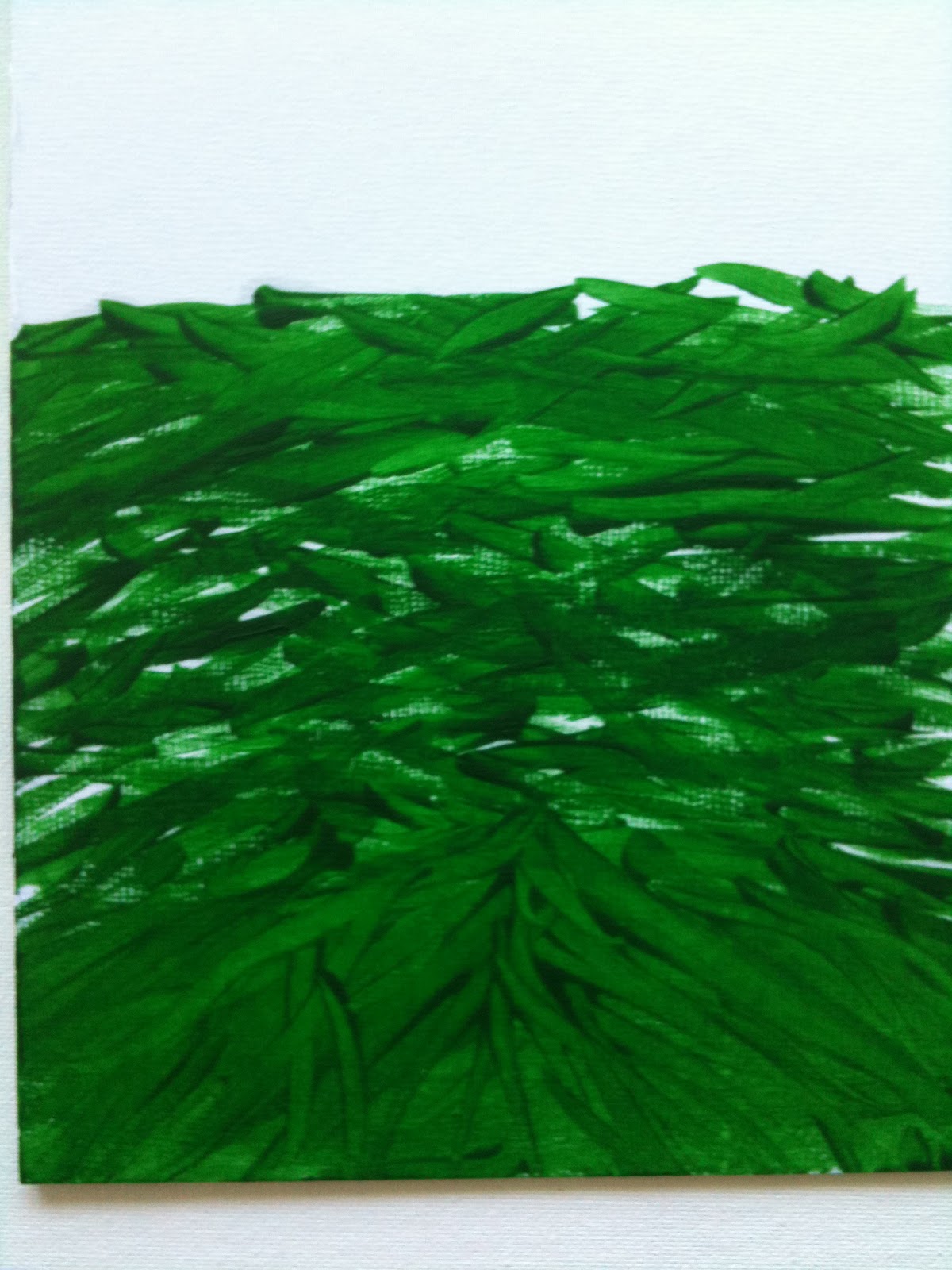
My other recent obsession, after decades of repeating in a robotic fashion "I am not a painter,"  is oil painting. I started out smearing oil paint on panels and wax as part of my encaustic endeavors; now I'm smearing it on canvases and even sometimes using a brush. I know almost nothing about oil painting, so I'm reacting 100% to what I see when the brush loaded with paint hits the canvas, and I'm learning how to control the brush enough to vary the effect. I'm working very very small right now, 3x5-inch canvases and canvasboard, a couple of 6x9's.
Earth
oil on canvas
3x5 inches

I don't know whether what I'm doing looks as cool as I think it does; it's entirely nonrepresentational and abstract, but it has feeling and motion in it, and it's clearly what I need to be doing right now. I'm almost always my own worst critic, but for the moment, I'm giving the critic the week off, and just enjoying doing things that aren't planned to death and then dissected because of my perception of their shortcomings.


Fire
oil on canvas
3x5 inches
Waveform
oil and encaustic on birch panel
8x8 inches


Ground (in progress)
oil on canvas panel
6x9 inches
 

Friday, February 18, 2011

Deep Analog

I've had a lot of ideas over the last few days, despite being sick (or maybe because I'm sick and I'm not actually leaving the house for anything other than feeding the horse), and I've gotten several new pieces into production. I am working on probably six different things right now; they're in various stages and represent a huge range of techniques, approaches, concepts, and goals. Encaustic is one of those artistic pursuits that involves a lot of waiting, interspersed with periods of hyperactivity ... kind of like chemical (as in, old school analog) photographic printing, actually, which is another one of my favorite things to do. One piece I loved, then ruined, then saved, then ruined again, but that's okay--I have a pretty good idea of how to re-save it, and because I'm working in encaustic, re-saving is in fact possible. Encaustic is kind of magical in how it permits the artist to undo what's been done up to a certain point; aside from oil painting, very few working media have this characteristic, and it's a quality I as a rank beginner really appreciate.

Even though I've always been primarily a photographer, I'm having trouble finding a way to combine my images with encaustic that feels "right" to me. I am still in the early stages of this investigation, and there are so many variables that it's mind-boggling. Slowly I'm lurching toward something, although it's still a process heavily in the "trial and error" phases.

More appealing to me, as you'll already know if you're one of the 2.3 regular readers of this blog, is the combination of oil paint with encaustic. I am not painter and never have been; I can't make a decent line with a brush on canvas, but for some reason using my fingers to apply oil paint onto surfaces or wax and then applying more wax (or more paint) is incredibly fulfilling. The paint, especially if you're using cheap oils, does amazing things when you fuse it into the wax; the pigment and oil separates somewhat and the liquid quality of the wax as it heats lets the paint move and flow into strange and interesting patterns and pathways. Higher quality oils will still run with the flow of overfused, liquid wax, but resist the interesting separation that creates such odd patterns within the painted sections. So I am using a blend of high quality and student-grade oils, with the cheap stuff where I want interesting scumbling and patterns and the better stuff where I want the paint to maintain its integrity when it is fused with the wax.

So far my favorite surface is a raw birch panel made specifically for use in art. I like being able to see the grain of the wood through the wax and feel the texture, and there is also something appealing in the idea that I'm using a host of organic materials in this process: pigmented oils, beeswax, wood, natural bristle brushes. (Certainly some of these organic materials can be wildly toxic, but that's nature for you.) And I'm also using my hands a lot, because that just seems to feel right. When you get right down to it, I have gone deep analog with my artmaking, and at the moment, it's incredibly satisfying.

Here are a few works in progress which I like, in various stages of development:

working title: Pink
Encaustic and oil on acrylic panel

This acrylic panel is transparent, so it will be interesting to see what it looks like when I remove the backing. I think I will probably apply one final overcoat of medium and overfuse to a smooth glasslike surface, then buff to a high shine.


working title: Rorshach
Encaustic and oil on cardboard canvas
panel
 This piece started out as a pure experiment, but now I'm thinking it's a study for a much larger piece that I'll produce in the future. (This is 6" x 9".) The  black is applied wax, which I allowed to cool, then added some simple lines with student-grade white oil paint. I then fused the paint into the wax by heating the surface until it liquified. I think to complete this piece I'll add some high-quality crimson oil paint to the line at right, and fuse lightly to preseve the integrity.


working title: Woodflow
Encaustic and oil paint on wood panel
 This last piece I feel is almost finished, although it needs one more thing ... I am not sure what that thing might be. I enjoy being able to see the grain of the wood through the paint, and the way the white paint (the student-grade paint) has separated a bit and started spreading in the middle of the panel. You can see here how the gold paint (artist quality) retained its integrity even though it was fused at the same time and to the same degree as the white.

I know there are a lot of little details in this new artistic practice that I need to get better on, like cleaning my brushes and paying better attention to safety details. Although really, I've spent so much of my life up to my elbows in black and white photo chemicals, if I'm going to be poisoned by something there's a good chance I already have been. And I might one day learn how to actually deliver oil paint to my surfaces with a brush. But right now this slap-dash, experimental, deep analog place I'm in feels just right to me.

Friday, February 11, 2011

Looking At Process

In tandem with my last post, I thought I should offer myself and the 2.3 regular readers of my blog a little roundup of the encaustic practices and processes I'm gravitating towards. This is, obviously, not going to be an all-inclusive list, and in reality it's just a little reminder to myself of the techniques I've tried that seemed to "work" for me very quickly. There are plenty of others that I imagine I'll find more appealing once I become better at them.

Here's the short list:

* Using paper to provide color. A sheet of really interestingly-colored paper used as background (either across the whole surface or in a strategic part of it) adds controlled color and brightness. This works best when I'm not planning to put a lot of layers of medium or other colors on top of the paper; the added wax soaks into the paper and dulls the colors or makes it take on the colors of whatever is layered beneath it. If you're using colored wax underneath the paper and planning for this effect, however, it can yield quite interesting results.

* Stamping on paper and integrating this into the image. Can either be a small piece of the image or the full background.

* Applying oil paint on the surface with my hands before augmenting it with pigmented wax and clear medium.

* Applying oil paint on the wax itself with my hands, and "sealing" it by fusing. I can't paint on canvas with a brush, but for some reason I can paint on wax with my fingers.

* Mixing up the application of wax and medium to the surface, so that some areas have wax and other areas are bare down to the surface (usually painted).

* Very simple straight carving into the wax, overfilling with an accent color, and scraping back to find the line.

* Moving pigmented wax around by overfusing it and letting it run on the panel.

* Using heat on a wax-dipped brush to spread pigment thinly.

* Adding scrapings of different colored waxes to the surface of pieces and expanding them in fusing.

* Overfusing generally.

* Burnishing the finished pieces to a glasslike shine.

* Creating diminsionality with a build up of layers of wax.

I haven't yet figured out how to use my photographic images with encaustic ... that's one of those things that I can already anticipate needs to be a bit thought out. The image and the wax have to make sense together, t enhance each other in order to make a cohesive statement. I'm working on this, though, and I don't think it will be long before I hit on an approach that makes me happy. I have a feeling I might enjoy working with colored inks also, and much more translucent colors. So far I've only used bristle brushes, but I'm reading about artists who use foam brushes, pouring techniques, and splatter approaches to distribute wax on the surfaces they use. In addition, there's a whole world of surfaces that I am anxious to try, and my investigations of those will most likely change the way I work.

I'm glad to have found this medium. There is something about working in it that feels right to me, in the same way photography and video did at the beginning, but also includes the hands-on aspect that I find so appealing about book arts. Maybe I did actually always want to be a painter ... with encaustic, it feels like maybe I am.